
Introduction
A few ants beside a driveway can look like a small, isolated problem. With big-headed ants, however, the activity you see may be one visible part of a much larger colony network extending through soil, landscaping, paver joints, slab edges, and neighboring properties.
That difference matters. Wiping up an indoor trail or treating one patch of loose soil may reduce activity for a while, but it does not necessarily reach the connected nests supporting it. A recurring ant infestation is often a property-wide problem that needs to be mapped before it can be managed well.
Big-headed ants are especially well suited to this kind of spread. They nest in soil, form colonies with multiple queens, and move through favorable outdoor areas rather than staying in one obvious mound. Homeowners may first notice sandy debris near a walkway, a trail at a window, or small reddish-brown ants in a bathroom. Understanding how those signs connect is the key to choosing the right response.
What Makes a Big-Headed Ant Infestation Different?
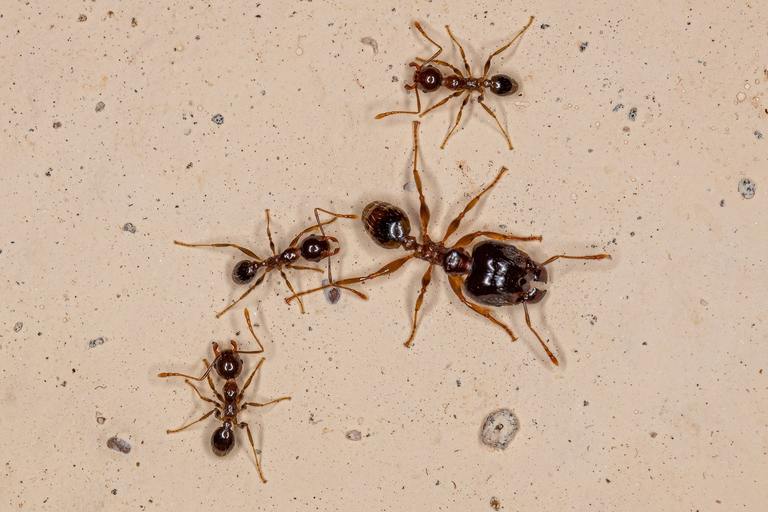
Big-headed ants, Pheidole megacephala, are invasive soil-nesting ants established in many warm regions. The species has two worker forms. Most workers are tiny and ordinary-looking, while a much smaller number are larger “major” workers with noticeably oversized heads. Because the major workers may make up only a small part of a trail, homeowners can miss the feature that gives the species its name.
According to the University of Florida's description of big-headed-ant biology and nesting behavior, these ants commonly leave loose sandy soil near walkways and driveways, forage into kitchens and bathrooms, and can maintain numerous colonies that extend across property lines. They do not sting or damage wood, but their numbers, soil movement, and ability to return from surrounding areas make them a persistent nuisance.
Their colony structure is the bigger issue. A single visible trail may connect to several nesting pockets. Queens, brood, and most workers remain protected underground while a small percentage of workers search for food and moisture. Killing those visible workers may change what you see without changing the colony behind them.
For a broader identification reference, homeowners can compare other common species in the ant pest library. Correct identification matters because big-headed ants do not behave exactly like fire ants, carpenter ants, ghost ants, or other household invaders.

How Does the Colony Spread Across a Property?
Big-headed ants expand through budding. Instead of relying only on winged reproductives to establish distant colonies, groups containing workers, brood, and queens can move into nearby suitable areas and form connected nesting sites. Over time, this can create a broad network rather than one centralized nest.
Warm soil, protected edges, steady moisture, and dependable food all support that expansion. Common routes and nesting zones include:
- Soil beneath pavers, stepping stones, and driveway edges
- Landscape beds with mulch, irrigation, or dense ground cover
- Gaps along slabs, foundations, patios, and pool decks
- Spaces beneath logs, pots, landscape timbers, and debris
- Protected areas around trees, palms, utility boxes, and irrigation components
- Cracks where exterior trails can enter wall voids or interior rooms
The network can also arrive with moved materials. Sod, nursery plants, soil, mulch, and landscape items may carry ants or colony fragments from one place to another. Homeowners should inspect new materials before installation and watch for fresh trails or soil piles after a landscape project.
This is one reason big-headed ants have become a common Florida concern. A property may offer dozens of small, protected nest sites, and the ants can continue moving between them as moisture, food, or weather conditions change.
What Are the Signs of an Ant Infestation Outdoors?
The most useful clue is not one ant. It is a repeated pattern across more than one part of the property. A homeowner may notice activity at a driveway in the morning, along a foundation later in the day, and near a sink after rain. When the same small reddish-brown ants appear in several connected zones, a larger network becomes more likely.
1. Fresh soil in hardscape joints
Big-headed ants excavate soil from beneath pavers, walkway edges, and cracks. The displaced material can look like fine sand or loose dirt pushed onto the surface. It may reappear soon after sweeping, especially near active openings.
This evidence does not automatically mean the ants caused major structural damage. Their tunneling is primarily a nesting and soil-displacement issue. Still, recurring excavation around settled pavers or slab gaps deserves attention because it reveals where part of the colony is active.
2. Fragile debris-covered tubes
These ants sometimes build narrow covered trails using soil and debris. The tubes can be mistaken for subterranean termite mud tubes, but big-headed-ant tubes are generally more fragile. Homeowners should avoid relying on appearance alone when tubes occur on a foundation or structural surface. A professional inspection can separate ant activity from evidence that calls for a specialized termite evaluation.
3. Trails between soil and the structure
Watch where workers travel, not only where they gather. Trails may follow expansion joints, plumbing penetrations, door frames, utility lines, window edges, or the protected seam where siding meets the foundation. Photographing the route before cleaning it can help an inspector connect indoor activity to the outdoor source.
4. Activity around honeydew-producing insects
Ants may climb plants to feed on honeydew produced by aphids, scales, mealybugs, or whiteflies. That food source can support outdoor populations close to the house. The ants do not create those plant pests, but they may protect them from predators while collecting honeydew.
Landscape inspection should therefore include the undersides of leaves, stems, trunks, and branches touching the structure. The integrated approach to ants in gardens and landscapes recommends addressing honeydew-producing insects, trimming plant bridges, and reducing favorable conditions near building walls.
5. Similar activity beyond one property line
If matching ants and soil deposits appear along a shared sidewalk, fence line, or neighboring landscape bed, the problem may extend beyond one yard. That does not mean a homeowner should treat someone else's property. It means expectations should account for possible reinvasion from connected habitat.
Why Do Big-Headed Ants Start Appearing Indoors?
Indoor sightings usually mean workers found a usable route to food, moisture, or shelter. Kitchens and bathrooms are common destinations, but trails may also appear in garages, laundry rooms, around pet feeding areas, or beside doors and windows.
Rain can flood shallow nesting areas and redirect foragers toward protected spaces. Hot or dry conditions can also increase the search for water. Landscape work, pressure washing, construction, or moving pots may disturb a nesting pocket and temporarily change trail patterns.
Finding workers indoors does not always mean the main nest is inside the wall. Many big-headed-ant problems begin outdoors, with foragers entering through tiny gaps. That is why wiping the counter and placing a product beside the last ant seen often produces disappointing results. The indoor trail may be only the end of a much longer route.
Homeowners can reduce immediate attractants by cleaning food residue, storing pantry goods and pet food securely, repairing leaks, and drying wet surfaces. These steps support control, but they rarely eliminate a mature colony network by themselves. A whole-home pest control inspection can evaluate the interior activity together with exterior nesting and entry conditions.
How Can You Map an Ant Infestation Before Treatment?
A simple property map can turn scattered sightings into useful evidence. You do not need special equipment. Use a rough sketch or phone notes and inspect during periods when ants are active.
Start with four zones
- Landscape zone: Check mulch, turf edges, tree bases, irrigation boxes, pots, stored materials, and ground cover.
- Hardscape zone: Inspect paver joints, driveway cracks, walkways, pool-deck seams, patios, and slab edges for fresh soil.
- Building perimeter: Follow trails around doors, windows, utility penetrations, weep openings, plumbing lines, and foundation gaps.
- Interior zone: Record the rooms, surfaces, time of day, weather, and attractants associated with sightings.
Take close photographs of workers beside a coin or ruler without disturbing the ants. Capture both the tiny workers and any large-headed workers you can find. Also photograph soil piles, covered trails, and the full travel route. This information makes species confirmation and treatment planning more efficient.
Recheck the same areas after rain, irrigation, yard work, or a sharp weather change. If activity moves rather than disappears, note the new location. That movement can reveal another nesting pocket or a route that a one-point treatment missed.
For larger properties, a professional can apply the same logic at a broader scale. Professional ant control services should begin with species identification, an assessment of infestation extent, and a plan matched to the colony's behavior.
Why Does an Ant Infestation Return After Spot Treatment?
Quick knockdown can be satisfying, but it is not the same as colony control. Contact sprays generally affect workers that cross a treated surface. They may never reach protected queens, brood, or workers in satellite nesting areas.
Several factors can make activity return:
- The visible trail represented only a small fraction of the colony.
- Another nesting pocket remained active nearby.
- A repellent treatment redirected workers to a different route.
- The ants ignored a bait that did not match their current food preference.
- Rain, irrigation, or cleaning affected product placement.
- Neighboring colony sections moved back into treated habitat.
- Food, moisture, or plant-based honeydew remained available.
Slow-acting baits can be useful because foraging workers have time to carry material back and share it within the colony. However, bait selection, placement, competing food, weather exposure, and species behavior all influence performance. The University of California's ant management guidance explains why baits must act slowly and why sprays that kill foragers quickly may provide only temporary relief from a major infestation.
Homeowners should follow every product label, keep pesticides inaccessible to children and pets, and avoid mixing homemade pesticide recipes. More product is not automatically more effective. With a widespread big-headed-ant network, professional oversight can prevent conflicting treatments and unnecessary pesticide use.

What Should a Property-Wide Control Plan Address?
An effective plan works from the colony outward. It should connect what the ants are doing with the conditions that let them thrive.
Confirm the species
The presence of two distinct worker sizes, including a few large-headed majors, supports big-headed-ant identification. Still, photographs and casual observation have limits. Fire ants and other soil-nesting species require different safety and control decisions.
Define the treatment area
The active area may be larger than the place where ants first appeared. Inspection should include the surrounding landscape, hardscape, perimeter, and indoor routes. Treating a single crack while ignoring a trail network across the yard invites rebound.
Match the method to colony behavior
Treatment may include carefully selected baits, targeted products, crack-and-crevice work, or other label-approved methods. The right combination depends on the site, weather, infestation extent, and where ants are nesting and feeding. Homeowners reviewing a customized pest control program should expect the plan to reflect those property-specific conditions.
Correct supporting conditions
Control lasts longer when the property becomes less favorable. Helpful changes may include:
- Repairing irrigation leaks and avoiding chronic overwatering
- Moving mulch and dense ground cover back from the foundation where practical
- Trimming branches and shrubs that touch the building
- Cleaning honeydew and addressing plant pests appropriately
- Storing pet food, bird seed, and outdoor food securely
- Removing unnecessary boards, pots, debris, and damp hiding places
- Sealing confirmed entry gaps after active trails have been assessed
These changes will not erase a large colony by themselves, but they reduce food, moisture, shelter, and travel routes that support it.
Monitor beyond the first reduction
Successful control should produce a sustained decline across all mapped zones, not merely an empty countertop for one afternoon. Fresh soil, new trails, or activity appearing at the edge of the treated area may signal a surviving pocket or reinvasion route.
When Should You Call a Pest Control Professional?
A few outdoor ants do not always require treatment. Many ant species contribute to soil processes and prey on other insects. Professional help becomes more appropriate when the activity is persistent, widespread, entering the home, difficult to identify, or returning after reasonable sanitation and exclusion steps.
Consider an inspection when:
- Soil piles reappear repeatedly across pavers or slab edges
- Trails occur in several outdoor and indoor locations
- You see both tiny workers and distinctly large-headed workers
- Activity extends toward neighboring properties or shared hardscape
- Debris-covered tubes could be confused with termite evidence
- Ants are active near electrical, utility, or inaccessible structural areas
- Store-bought treatments shift the trail without producing lasting control
- Children, pets, or sensitive landscaping complicate product placement
The goal is not simply to kill every ant visible that day. It is to understand which species is present, how far the colony extends, what is sustaining it, and which response can reduce the network without creating avoidable risk.

A Wider View Leads to Better Ant Control
Big-headed ants reward careful observation. Their most important clues are often spread across the property: fresh soil beside a paver, workers climbing a honeydew-covered plant, a trail along a slab seam, and a few foragers entering near plumbing.
Seen separately, each clue looks minor. Seen together, they can reveal the shape of an ant infestation that spot treatment will not solve. Mapping the activity, confirming the species, correcting favorable conditions, and targeting the colony network gives homeowners a clearer path toward lasting control.
Professional help is most valuable when it turns scattered signs into one coordinated plan. That measured approach protects the home, limits unnecessary pesticide use, and makes it easier to recognize whether the colony is truly declining or simply moving to a new route.