
Introduction
If you spot a small gray nest under an eave, porch ceiling, shutter, mailbox, or playset, you may be looking at a paper wasp nest. These wasps favor protected outdoor spaces around homes, and queens start new nests in spring before colonies expand through summer. Small early nests are easy to ignore, but that is also when homeowners have the best chance to deal with the issue before daily foot traffic turns it into a sting risk.
A paper wasp nest becomes a bigger concern when it is close to a front door, patio dining area, grill, pool gate, garage path, or any spot people pass without thinking. Paper wasps are usually less aggressive than yellowjackets, but they will defend a nest if they feel it is threatened. If you are already seeing repeated flight in and out of the same sheltered corner, professional wasp control services are usually a safer next step than trial-and-error spraying.

What does a paper wasp nest look like?
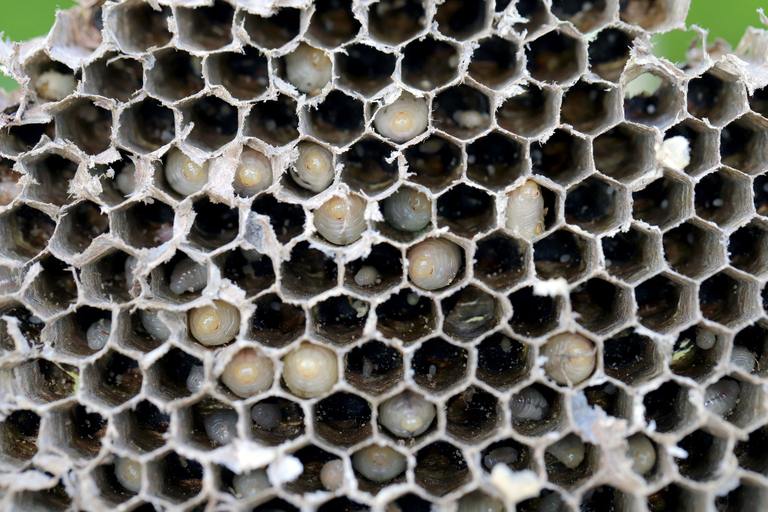
The classic paper wasp nest looks like an open umbrella or a small upside-down comb. Instead of being wrapped in a thick outer shell, the hexagonal cells are exposed and attached by a thin stalk to the surface above them. Paper wasps build this structure from chewed wood fibers and saliva, which gives the nest its dry, papery appearance.
That open-comb shape is the quickest clue for homeowners. If you can see the individual cells from below, and the nest is hanging in the open rather than sealed inside a rounded paper ball, you are likely not dealing with yellowjackets or hornets. Paper wasps also tend to look slimmer than bees, with long legs that hang down while they fly.
Paper wasp nest vs yellow jacket nest
This is where many homeowners get tripped up. A paper wasp nest is open and exposed. A yellowjacket nest is usually enclosed in a paper envelope, and in many cases it is hidden underground, in a wall void, or in another cavity. That distinction matters because yellowjackets are generally more defensive and harder to locate accurately when the nest is concealed. If you want a broader comparison point for stinging pests and other common invaders, All U Need's pest library is a useful place to start.
One more point is worth clearing up. Paper wasps may scrape weathered wood fibers to build nests, but they are not eating your house the way termites do. If you are seeing hollow trim, mud tubes, discarded wings, or real structural wood warning signs, that is a different problem that lines up much more closely with termite treatment and prevention.

Where do homeowners usually find a paper wasp nest?
Paper wasps choose places that are sheltered from heavy rain and casual disturbance. Around homes, that often means roof overhangs, porch ceilings, shutters, light fixtures, deck rails, fence sections, storage sheds, outdoor furniture, play equipment, and similar protected spots. The nest may start in a place you barely notice until the colony grows enough that flight activity becomes obvious.
The most common high-risk locations include:
- under eaves and soffits near entry doors, where people can pass within inches of a nest without seeing it right away
- around shutters, grills, playsets, porch furniture, and protected fixtures that stay still long enough to feel safe to a queen wasp
- on shrubs, small tree branches, or outbuildings, where the nest blends into the background and goes unnoticed longer
What homeowners often miss is that visibility is not the same as safety. The real question is not only how big the nest is. It is how close that nest is to normal daily movement. A modest colony in the wrong spot can create more trouble than a larger nest in a quiet corner of the yard.
Is a paper wasp nest dangerous?
The answer depends on location, household risk, and how likely the nest is to be disturbed. Paper wasps do help by hunting insects to feed their young, but that does not make a nest near your home harmless. Once a colony is established in a high-traffic area, routine activities like bringing in groceries, mowing, opening a gate, cleaning patio furniture, or trimming shrubs can trigger defensive behavior.
Most stings cause immediate pain, redness, and swelling at the site. The more serious concern is an allergic reaction. MedlinePlus notes that anaphylaxis can include trouble breathing, trouble swallowing, swelling of the face or mouth, fainting, chest pain, or widespread rash and flushing, and it requires emergency care.
When is a sting reaction an emergency?
Call emergency services right away if someone who was stung develops trouble breathing, trouble swallowing, swelling of the face or mouth, fainting, lightheadedness, or signs of a whole-body allergic reaction. Even when symptoms seem to improve at first, severe reactions can escalate quickly.
A non-emergency sting can still be a warning sign for the property. If one person gets stung while gardening, pressure washing, taking out the trash, or walking through a side yard, there is a strong chance the nest is positioned where it can catch someone else off guard too. That is usually the point where prevention stops being theoretical and becomes a household safety issue.

Should you remove a paper wasp nest yourself?
This is the question most homeowners ask first, and the honest answer is that a nest can be more risky than it looks. UF/IFAS notes that people are often stung while trimming shrubbery or cleaning nests from eaves, and paper wasps readily sting when a nest is disturbed. That is why even a nest that seems small can turn into a bad situation fast when it is overhead or close to where people have to work.
There is also a common mistake that creates bigger problems: someone treats the visible spot, assumes the problem is over, and goes back to normal activity too soon. If nests keep showing up around the same parts of the house, a customized pest control program is usually a better fit than a one-step fix because it builds in inspection, treatment, and follow-up around the property instead of focusing on a single moment.
Another important seasonal detail is that queens start new nests in spring, colonies grow through summer, and the colony dies off in fall. Old nests are not the same as active nests, but an empty nest does not mean the location has stopped being attractive. The protected spot is still there, and new queens may choose similar nearby areas the next season.
How can you keep another paper wasp nest from showing up?
A lasting fix usually comes from making the structure less inviting, not just knocking down visible nests. Homeowners get the best results when they combine early observation with simple maintenance steps before a colony becomes established.
Focus on these prevention habits:
- Check eaves, porch ceilings, shutters, grills, shed interiors, mailbox covers, and play equipment early in the warm season, when a new nest is still small and easier to spot.
- Repair loose trim, damaged screens, and sheltered cavities that create protected nest-starting zones around the exterior.
- Inspect before power washing, pruning shrubs, moving outdoor furniture, or opening long-unused storage spaces, because those disturbances often bring homeowners too close to active nests.
- Watch recurring hot spots from previous years, because queens often look for the same kinds of quiet, protected surfaces.
If your home seems to attract multiple pests as the weather changes, not just wasps, a broader review of homeowner resources can help you think beyond one nest at a time. All U Need's family- and pet-friendly approach is built around inspection, communication, and treatment tailored to the property rather than one generic spray pattern.

When should you call a professional about a paper wasp nest?
Call sooner rather than later if the nest is above a door, in a play area, near patio seating, attached to a structure you need to touch regularly, or active enough that wasps are coming and going throughout the day. The same goes for nests near rooflines, upper-story trim, or any location that forces a close approach. Those are the situations where a manageable-looking problem becomes much less predictable.
You should also call if you are not completely sure what you are seeing. A visible paper wasp nest is one thing. Hidden yellowjacket activity in a wall, soffit, or ground void is another. Misidentifying the nest often leads to the wrong response, and wrong responses around stinging insects tend to go badly.
Professional help is not about dramatizing every wasp sighting. It is about matching the response to the risk. A single wasp hunting in the yard is not the same as a nest over the back gate your family uses ten times a day. If you are seeing repeat activity around the home, All U Need Pest Control can pair removal with a broader inspection strategy so the next nest is less likely to catch you by surprise.
Final thoughts
A paper wasp nest is one of those problems that looks manageable until it is in exactly the wrong place. The nest may start small, but location, visibility, and household risk matter more than size alone. If the activity is near doors, patios, grills, play spaces, or anywhere people move without looking up first, quick action is usually the smart move.
The good news is that homeowners do not need to guess. Once you know the open-comb shape, the sheltered spots paper wasps prefer, and the warning signs that raise the risk, you can make better decisions earlier. That is usually the difference between noticing a nuisance and preventing a painful, avoidable problem around the home.