Termite Wings vs Flying Ant Wings: What Homeowners Should Notice First

Published: May 19, 2026
Introduction
If you find a cluster of loose wings on a windowsill, a few winged insects near a porch light, or a sudden indoor swarm around a door or lamp, it is easy to panic. It is also easy to misidentify what you are seeing. Homeowners commonly confuse termite swarmers with flying ants because both can appear suddenly, both have wings, and both tend to show up during warm, humid weather.
The good news is that you can usually make a strong first identification by focusing on the wings before anything else. Termite wings tend to follow a very consistent pattern, and once you know what to look for, the visual differences become much easier to spot.
This guide walks through the fastest wing-based clues, what those clues may mean for your home, and when a simple sighting should lead to a professional inspection. If you want more background on termites with wings, flying termites and what swarmers mean, or broader termite treatment and prevention, those pages can help you keep reading after this comparison.
What Is the Fastest Rule of Thumb for Identification?
We’ll go into more detail below, but If you want the fastest possible rule for the moment you spot them, use this:
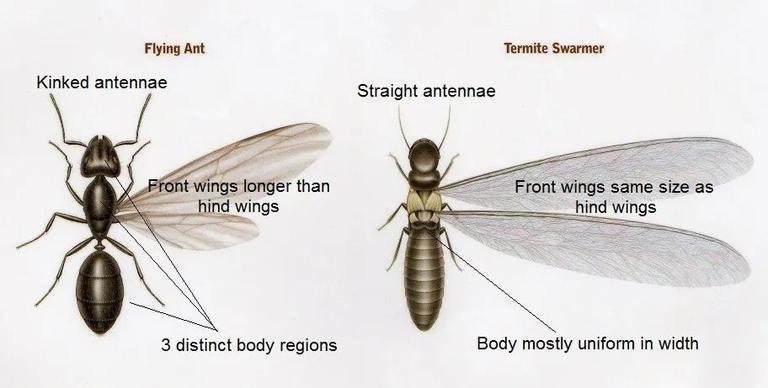
- Equal wings, straight waistline, straight antennae: think termites.
- Uneven wings, pinched waist, elbowed antennae: think ants.
That quick check is not a substitute for a full inspection, but it is a very strong starting point.
Why Homeowners Mix These Up So Often
Both termites and ants produce winged reproductive insects. These winged forms emerge when a colony is mature enough to reproduce and spread. Because of that, both pests can seem to come out of nowhere.
A homeowner might notice:
- winged insects near windows or glass doors
- bugs gathering around interior lights or porch lights
- small piles of wings on floors, sills, or counters
- a short burst of activity that seems to disappear by the next day
That overlap is exactly why the comparison gets tricky. The important difference is not just that one insect flies and the other does not. The real difference is what the swarm is telling you. A flying ant swarm can be a nuisance or a sign of a nearby ant nest. A termite swarm can be a warning that a mature termite colony is already established close to, or even inside, the structure.
According to NC State’s termite swarmer guidance, termite swarmers usually come from a nearby colony, and their shed wings are often one of the clearest warning signs homeowners find.
What Do Termite Wings Look Like at First Glance?
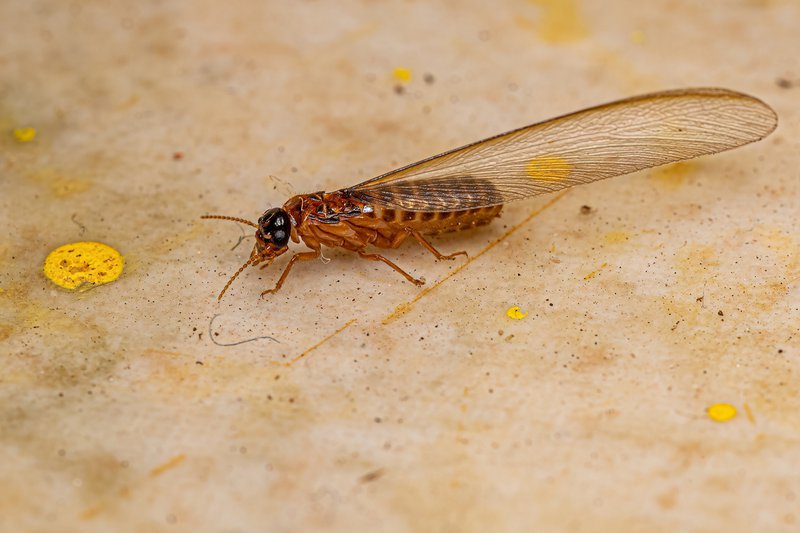
If you remember only one thing, remember this: termite wings are usually equal in size.
That one detail helps homeowners sort through a lot of confusion quickly.
When termites swarm, they have four wings that are:
- nearly equal in length
- longer than the body
- pale or translucent in appearance
- delicate and easy to shed
Flying ants also have four wings, but the front pair is longer than the back pair. That uneven wing pattern is one of the fastest ways to separate the two.
You may not always want to get close enough to inspect body segments right away. Sometimes the wings themselves give you the best first answer, especially when the insects are dead, crushed, or partially hidden.
The NC State ant identification guide explains this distinction clearly: ants have a larger front wing and a smaller rear wing, while termites have four wings of roughly the same size.
What Should You Compare Besides the Wings?
Wings are the best starting point, but they are not the only clue. If you can get a closer look, compare these three features together:
1. Waist shape
Termites have a broad, straight-looking waist.
Flying ants have a narrow, pinched waist that looks more segmented.
2. Antennae
Termites have straight, bead-like antennae.
Flying ants have bent or elbowed antennae.
3. Wing proportions
Termites have four wings of similar length.
Flying ants have front wings that are noticeably longer than the back wings.
If you are unsure, compare the body and wing clues together instead of relying on one feature alone. That is especially helpful when the insects are small or when some wings have already broken off.
For a broader anatomy guide, All U Need also has a useful page on what termites look like.
Why Do Termite Wings Show Up Near Windows and Lights?
Homeowners often first notice termite wings after the insects gather near light sources or drift toward windows and doors. That is normal swarming behavior.
Subterranean termite swarmers are often attracted to light, which is why loose wings turn up in predictable places such as:
- windowsills
- sliding door tracks
- entryway floors
- bathroom windows
- lamps and light fixtures
- spider webs near windows or vents
Swarmers are commonly found around window sills, doors, lights, and vents, and that homeowners often discover the wings after the insects break them off. This matters because a pile of wings is not random debris. It is a leftover sign from a reproductive swarm. Even if you do not see live insects anymore, the wings can still be the most useful evidence left behind.
Are Loose Wings More Important Than the Bugs Themselves?
Often, yes.
Live swarmers can disappear quickly. They may die, lose their wings, get cleaned up, or scatter into hidden areas. The wings tend to linger longer, which makes them one of the most practical clues a homeowner can find.
A small pile of shed wings can suggest:
- a recent swarm occurred very close by
- winged termites made it indoors before dropping their wings
- a colony may be established somewhere nearby
- the problem deserves inspection even if the insects are gone now
This is one reason termite wings deserve attention even when you never actually saw the swarm happen. Homeowners sometimes wake up, find wings near a window, and assume the issue has passed. In reality, the visible activity may be over while the underlying termite problem remains.
What If You See Flying Ants Instead?
Flying ants still deserve attention, but the meaning is usually different.
Flying ants can emerge from an indoor nest or an outdoor colony near the structure. In many cases, they are less destructive than termites, though some species, especially carpenter ants, can still point to moisture-damaged wood and hidden nesting areas. If the insects turn out to be ants, you may need ant control services or help figuring out how to get rid of flying ants.
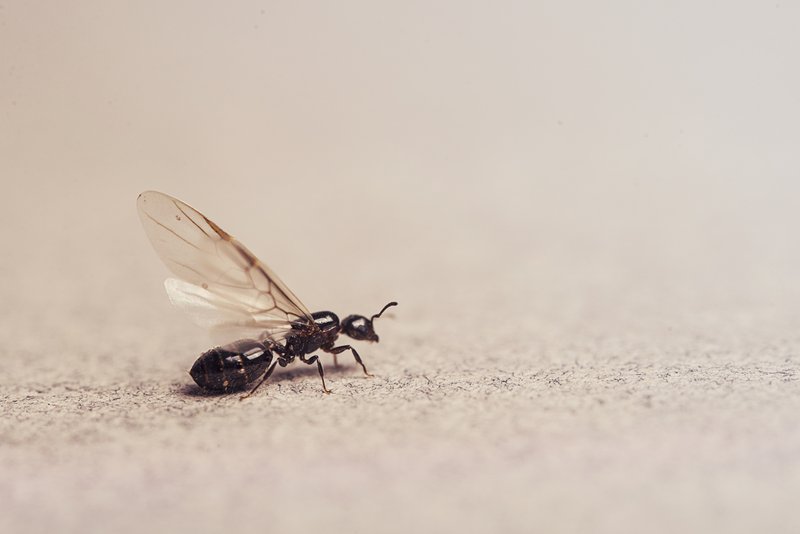
A flying ant swarm is more likely to show:
- a thin waist
- elbowed antennae
- front wings larger than the back wings
- movement patterns that feel more erratic and ant-like on surfaces
That does not mean you should ignore them. It just means the risk profile is different. With termites, the concern is hidden structural feeding. With ants, the concern is more likely to be nuisance activity, nesting in wall voids, or moisture-related wood issues depending on the species.
What Does It Mean If the Wings Are Indoors?
Indoor evidence usually deserves more urgency than outdoor evidence.
If you find wings outside, there is still reason to pay attention. A nearby colony may be on your property, in a stump, in landscaping timbers, in a fence line, or in a neighboring structure. But when you find the swarm or the wings inside, the concern becomes more immediate.
Indoor swarms can suggest that termites emerged from within the structure itself. That does not always mean severe damage is already present, but it is a stronger warning sign than an isolated outdoor sighting.
Pay especially close attention if you find wings:
- on interior windowsills
- near baseboards
- in bathrooms or laundry rooms
- around attic access points
- near exterior-facing doors
- in rooms with prior moisture issues
The EPA termite consumer guidance also highlights discarded wings as one of the classic warning signs homeowners should watch for.
Can Termite Wings Appear Without Live Termites?
Yes, and that is one reason homeowners sometimes underestimate the issue.
A swarm can be brief. By the time you notice the aftermath, the live insects may already be gone. You may find termite wings without seeing a single active swarmer.
That can happen when:
- the swarm occurred overnight
- the insects shed wings quickly and died
- household cleaning removed some of the evidence
- the swarm happened in a low-traffic room
- the insects emerged near a vent, window, or hidden gap
In other words, no live insects does not mean no termite issue. The wings may be the only clue you get.
What Should Homeowners Do First?
If you are trying to tell whether you have termites or flying ants, avoid spraying first and identifying later. A quick spray can scatter insects and remove the evidence you need.
Instead, take these steps:
- Take clear photos of the insects and any loose wings.
- Look closely at wing size, waist shape, and antennae.
- Check windowsills, door tracks, baseboards, and nearby floors for more wings.
- Look for other termite signs such as mud tubes, damaged wood, or blistering paint.
- Note where and when the insects appeared.
- Arrange a professional inspection if the evidence points to termites or if you cannot tell the difference confidently.
This approach helps you preserve the clues that matter. It also gives a technician much better information if an inspection is needed.

When Is It Probably Time to Call a Professional?
You should move beyond DIY identification and schedule professional help when:
- you find repeated piles of wings
- the wings are indoors
- the insects match termite body features
- you notice mud tubes or damaged wood nearby
- the swarm happens around the same part of the house more than once
- you are not fully confident that you are looking at ants
A termite problem can stay hidden long after the swarm is over. That is why homeowners should treat wing evidence seriously, especially in spring and early summer when swarming activity becomes more common.
Final Thoughts
When homeowners panic over swarmers, they often focus on the insects moving around the room. In many cases, the more useful clue is what gets left behind. A small pile of wings near a window or door can tell you more than a few seconds of live activity ever will.
That is why termite wings matter so much. They can help you separate a nuisance ant swarm from a termite warning sign before the opportunity to identify it disappears. If the wings are equal in size, the body is thick rather than pinched, and the evidence is turning up indoors, it is smart to assume the issue needs real attention.
The goal is not to overreact to every winged insect you see. The goal is to notice the right details early, respond calmly, and get expert help before hidden structural damage has more time to spread.