Big Headed Ants: Now One of the Most Common Ants in Florida

Published: December 26, 2023
Introduction
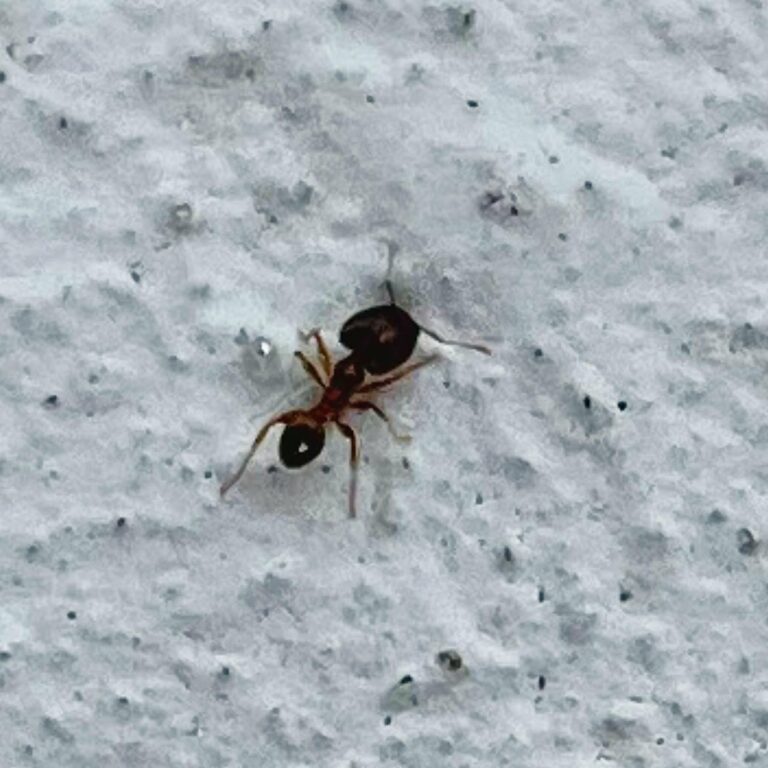
Tiny reddish-brown ants are easy to dismiss until fresh soil starts appearing beside the driveway, pavers, foundation, or kitchen wall. When a few workers become long trails and the same activity returns after spraying, the problem may be a connected network of big headed ants rather than a single small nest.
Big headed ants are invasive soil-nesting ants that thrive in warm climates, disturbed landscapes, and developed areas. They are especially noticeable in Florida, where sandy soil, irrigation, dense landscaping, and year-round warmth give colonies many protected places to expand. Most activity begins outdoors, but workers may enter homes while searching for food, water, or shelter.
The best way to manage these ants is to identify them correctly, trace where the colony is active, and use a plan that reaches more than the workers visible on the surface. This guide explains the signs homeowners can recognize, why common quick fixes often fail, and what effective control should accomplish.
What Are Big Headed Ants?
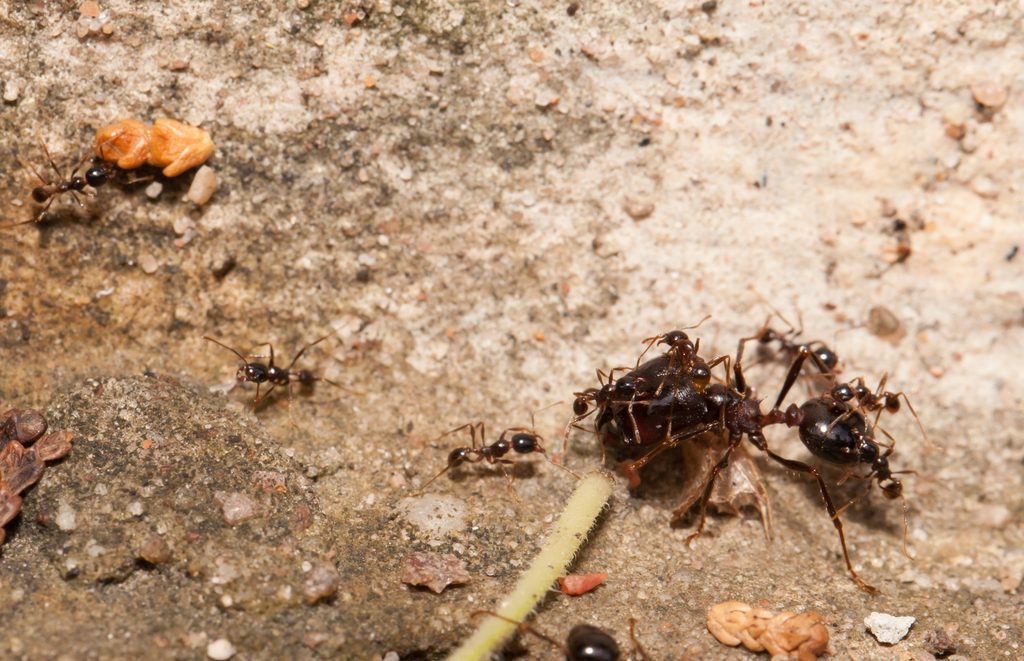
The species most often associated with serious infestations is Pheidole megacephala. Its common name comes from the colony’s two worker forms. Minor workers are small and perform most of the foraging, brood care, and nest maintenance. Major workers are larger and have heads that look disproportionately wide compared with their bodies.
That size difference is called worker dimorphism. It is one of the most useful identification clues because both worker types can appear in the same trail. A homeowner may first notice dozens of tiny workers, then spot a few larger ants that seem to belong to another species. In reality, they may be members of the same colony.
University of Florida specialists describe this species as a widespread household and agricultural pest and report that it is found throughout much of peninsular Florida. Their detailed bigheaded ant species profile also notes its preference for disturbed habitats and its habit of excavating soil around objects and paved areas.
For a broader look at common species and why correct identification affects treatment, homeowners can review our ant pest library.
What Do Big Headed Ants Look Like?
Color alone is not enough to identify an ant. Depending on lighting, age, and the individual worker, these ants may look yellowish brown, reddish brown, or dark brown. Their shape, worker sizes, nesting evidence, and movement pattern are more useful.
Look for this combination of clues:
- Numerous small minor workers moving in organized trails
- Fewer major workers with unusually large, blocky heads
- Yellowish-brown to reddish-brown coloring
- A narrow waist and elbowed antennae, like other ants
- Loose, sandy soil pushed from cracks, lawn edges, pavers, or slab joints
- Heavy activity along driveways, curbs, foundations, flower beds, and irrigation lines
Minor workers are only a few millimeters long, so the large-headed majors are often the easiest feature to photograph. Place a coin near the trail for scale without disturbing it. Clear close-up images of several workers, plus pictures showing the trail and soil deposits, can make professional identification much easier.
Why Does Fresh Soil Keep Appearing Beside Pavers?
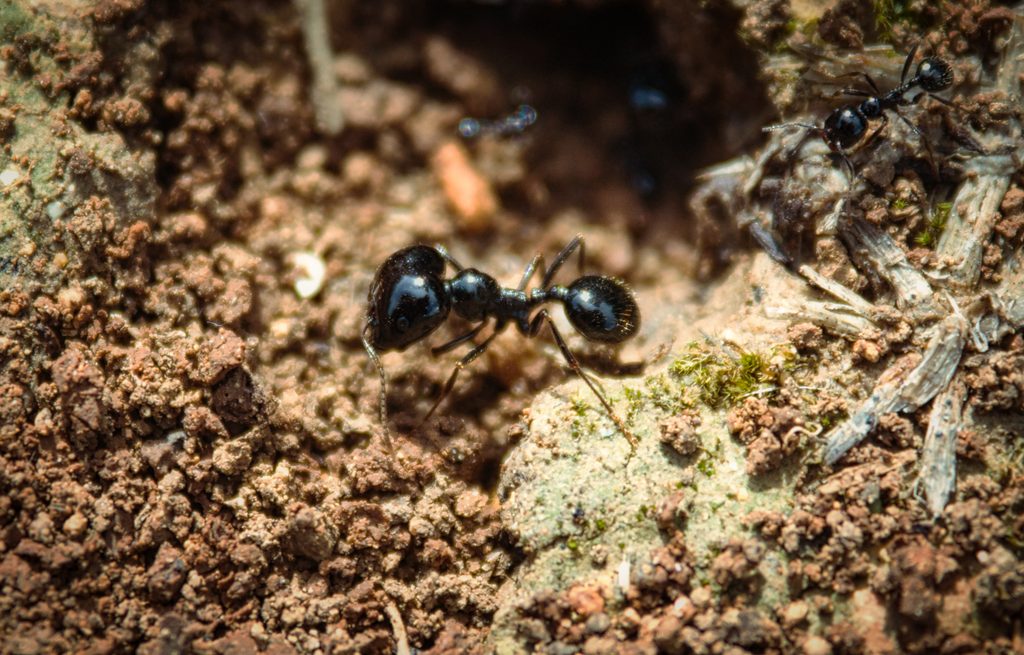
These ants excavate extensive nesting spaces in soil. Workers carry loosened particles out of nest openings and deposit them around cracks or edges. The result can look like fine dirt, sand, or grit that returns soon after it is swept away.
Recurring soil beside a driveway, patio, pool deck, foundation, or stepping stone is more informative than a random pile of dirt. Watch for active workers entering and leaving a small opening. Do not put your hands into a suspected nest because a different stinging ant species could be present.
Where Do These Ants Build Their Nests?
Most colonies begin and spread outdoors. Common nesting locations include:
- Beneath pavers, stones, concrete slabs, and landscape edging
- Along cracks in driveways, patios, sidewalks, and foundations
- In lawns, mulch beds, and irrigated planting areas
- Under logs, boards, pots, debris, or other ground-level objects
- Around tree roots, sprinkler components, utility boxes, and pipe penetrations
- Inside wall voids or other protected spaces when conditions allow
Moisture matters, but the ants do not need a visible puddle. Irrigated soil, shaded mulch, condensation, roof runoff, leaking hose connections, and poor drainage can maintain favorable conditions. Research on introduced Pheidole ants describes the species as an adaptable generalist that occupies humid, disturbed environments and can form expansive colonies with multiple queens.
Multiple nesting sites may function as one connected population. That helps explain why activity can stretch from a sidewalk to a side yard, across a driveway, and up to the house. Treating one visible opening may leave many queens, workers, and brood untouched.
Why Are They So Common Around Florida Homes?
Florida properties often combine the exact conditions these ants use: warm temperatures, sandy or loose soil, frequent rain, irrigation, hardscape seams, mulch, and abundant food. Development also creates edges and cracks where colonies can establish protected nest chambers.
These ants eat a broad range of foods. Outdoors, they scavenge dead insects, prey on small arthropods, collect seeds, and feed on honeydew produced by sap-feeding insects. Indoors, workers may investigate grease, proteins, sweets, pet food, crumbs, and moisture.
Their success is not only a household nuisance. Invasive populations can displace other invertebrates and dominate food resources. Federal research on the ecological effects of invasive ants has documented how this species can exclude other ants from food sources and reduce native ant diversity in infested settings.
Does Seeing Them Mean the Nest Is Inside?
Not necessarily. Workers commonly travel indoors from outdoor nests through tiny gaps. A kitchen trail may lead through a plumbing penetration, under a door threshold, or along a slab crack while the main nesting network remains outside.
Indoor nesting becomes more plausible when workers consistently disappear into an interior wall or floor void, activity continues far from exterior walls, or ants are associated with a persistent moisture problem. Our guide to reading ant trails into the home explains how to preserve those movement clues before cleaning the area.
Are They Dangerous to People or Property?
They are primarily a nuisance and invasive landscape pest. They are not known for the painful, defensive stinging behavior that makes fire ants a direct safety concern in lawns and play areas. Any ant may bite when handled, but these ants generally do not present the same sting hazard as red imported fire ants.
They also do not eat wood like termites or excavate structural wood in the way carpenter ants can. Their main household impacts are persistent foraging, food contamination concerns, nesting under hardscape, soil displacement, and the difficulty of managing a large connected population.
Even so, identification matters. Small reddish ants near soil can be confused with stinging species, and large-headed workers may lead homeowners to assume they have carpenter ants. Avoid handling unknown ants or disturbing a mound simply to test their reaction.
Big Headed Ants vs. Fire Ants: What Is the Difference?
Both species can live in soil and appear reddish brown, but their workers, nests, and behavior differ.
| Clue | Big headed ants | Fire ants |
|---|---|---|
| Worker pattern | Many tiny workers plus fewer majors with oversized heads | Workers vary in size, but majors do not have the same exaggerated head shape |
| Nest evidence | Fine soil along pavers, cracks, foundations, and landscape edges | Dome-shaped mounds are common, although an entrance hole may not be obvious |
| Defensive behavior | Generally not aggressive toward people | Workers rapidly defend disturbed nests and can sting repeatedly |
| Common concern | Persistent trails, widespread nesting, soil displacement, indoor foraging | Painful stings and unsafe lawns or activity areas |
| Typical response | Trace the full activity zone and target the connected colony | Avoid disturbing the mound and use a fire-ant-specific control plan |
If ants rush out and sting when the soil is disturbed, move away and do not continue testing the nest. Review our guide to recognizing and managing fire ants instead.
How Does Effective Colony Control Work?
Effective control usually combines targeted treatment, environmental correction, exclusion, and follow-up. The exact products and placements depend on the size of the activity zone, weather, site conditions, and whether ants are feeding indoors.
1. Map the Infestation
Inspect the property when workers are active. Follow trails in both directions and mark soil deposits, cracks, landscape edges, and indoor entry points. Check the entire perimeter, not just the area with the largest pile of soil.
2. Confirm the Species
Major workers provide an important clue, but several ants should be examined together. Correct identification prevents a plan meant for fire ants, carpenter ants, or tiny indoor ants from being applied to the wrong pest. If large workers are associated with damp wood or coarse wood debris, compare the evidence with our Florida carpenter ant identification guide.
3. Select Treatment for the Colony and Site
Professionals may use baits, nonrepellent materials, direct nest treatments, or a combination based on the inspection. Baits must be attractive to the colony at that time and placed where workers can find them without exposure to children, pets, rain, or cleaning products. Exterior treatments must account for irrigation, drainage, flowering plants, and nearby water.
There is no responsible one-product prescription for every property. Applying pesticides more often or at a higher rate than the label allows is unsafe and may make the problem harder to assess. Homeowners should use only products labeled for the pest and treatment site and follow every label direction.
4. Reduce Conditions That Support the Ants
Treatment works better when the property offers fewer nest sites and food sources. Repair leaks, correct overwatering, clean food residue, manage trash, and address sap-feeding insects that produce honeydew. Remove unnecessary boards, stones, and debris lying on soil near the structure.
5. Monitor and Adjust
A successful program should reduce worker traffic, fresh soil deposits, and the geographic spread of activity. Follow-up inspections reveal whether trails are shrinking, moving, or reappearing from untreated areas. Large infestations may require repeated evaluation rather than one appointment.
What Can Homeowners Do Before Service?
A few simple steps can protect evidence and make the inspection more productive:
- Photograph several ants and the surrounding nest evidence.
- Note when and where trails are most active.
- Avoid spraying or washing away every trail just before the appointment.
- Store food and pet food in sealed containers.
- Clean grease, crumbs, sugary spills, and trash residue.
- Repair dripping faucets, hose bibs, and irrigation components.
- Move mulch, firewood, and stored materials away from the foundation where practical.
- Keep children and pets away from unknown ant nests.
- Save a specimen in a sealed container only if it can be collected without contact or risk.
Do not drill into walls, pull up pavers, flood nests, mix pesticides, or pour flammable liquids or boiling water into cracks. Those actions can cause injury, damage property, contaminate the environment, or scatter activity without reaching the full colony.
How Can You Help Prevent Another Infestation?
Prevention will not create an ant-proof yard, especially in warm climates, but it can make the structure less accessible and the immediate perimeter less favorable.
Improve the Exterior Perimeter
Seal visible gaps around utility lines, pipes, door frames, windows, and slab joints with materials appropriate for the surface. Replace damaged weather stripping and repair screens. Keep branches and dense vegetation from touching the building.
Manage Water and Landscaping
Adjust sprinklers so they do not constantly wet the foundation. Correct drainage problems, clear gutters, and avoid piling thick mulch against exterior walls. Use only the amount of irrigation the landscape needs.
Remove Food Sources
Rinse recycling, keep trash containers clean and closed, pick up fallen fruit, and avoid leaving pet food outdoors. Check plants for scale insects, aphids, or mealybugs when ant trails repeatedly run up stems or trunks.
Watch for Early Signs
Fresh soil at a paver seam or foundation crack can be easier to address than a trail network spread across the property. Include ant activity in routine checks of patios, pool decks, driveway edges, utility areas, and the home perimeter. Homeowners across our pest control service areas can use these signs to decide when recurring activity deserves a closer inspection.
When Should You Call a Pest Control Professional?
Professional help makes sense when the activity covers multiple areas, returns after reasonable sanitation and exclusion, reaches indoor rooms, or cannot be safely distinguished from fire ants. It is also appropriate when nests appear under extensive pavers or slabs, around utilities, near pools, or across shared property boundaries.
A useful inspection should answer several questions:
- Is the ant correctly identified?
- How large is the active area?
- Are the indoor ants foraging from outside or nesting in the structure?
- Which moisture, landscape, or food conditions are supporting the colony?
- What treatment approach fits the site?
- How will progress be measured during follow-up?
Big headed ants can be persistent, but persistence is not the same as impossibility. A property-wide view, correct species identification, and treatment that accounts for multiple queens and connected nests give homeowners a much better chance of lasting relief than chasing each new trail with a contact spray.

The Bottom Line
Big headed ants are best recognized by their two worker sizes, recurring soil deposits, organized trails, and tendency to spread through soil and hardscape edges. They usually begin outdoors, but their colonies can become large enough to produce repeated indoor foraging and activity across several parts of a property.
The practical response is to document the signs, avoid unsafe nest disturbance, reduce food and moisture, seal entry points, and use colony-focused control when the problem persists. The sooner the full activity zone is understood, the easier it is to avoid temporary fixes and build a plan around the actual source.