Florida Carpenter Ants: Find the Source and Protect Your Home

Published: August 26, 2026
Introduction
Large reddish and black ants moving along a lanai, windowsill, roofline, or kitchen wall can be hard to ignore. In Florida, warm temperatures, frequent rain, high humidity, mature trees, and moisture-prone building materials give carpenter ants plenty of places to live and forage. A few ants indoors may have wandered in from an outdoor nest, but repeated sightings can point to a hidden moisture or nesting problem that deserves a closer look.
Florida carpenter ants do not eat wood the way termites do. They excavate wood and other materials to create nesting space. That difference matters, but it does not make an established colony harmless. Over time, galleries can enlarge inside wood that may already be weakened by a leak or decay.
The best response is to identify the ant, determine whether the nest is indoors or outdoors, correct the conditions supporting it, and use treatment that reaches the colony rather than only the workers you can see.
What Are Florida Carpenter Ants?
The name refers to several carpenter ant species found in the state. Two common species around Florida structures are Camponotus floridanus and Camponotus tortuganus. They are among Florida’s largest ants and are often noticed while foraging or during seasonal mating flights. The Florida carpenter ant species profile from UF/IFAS explains that these ants are common around structures and may appear in alarming numbers during flight season.
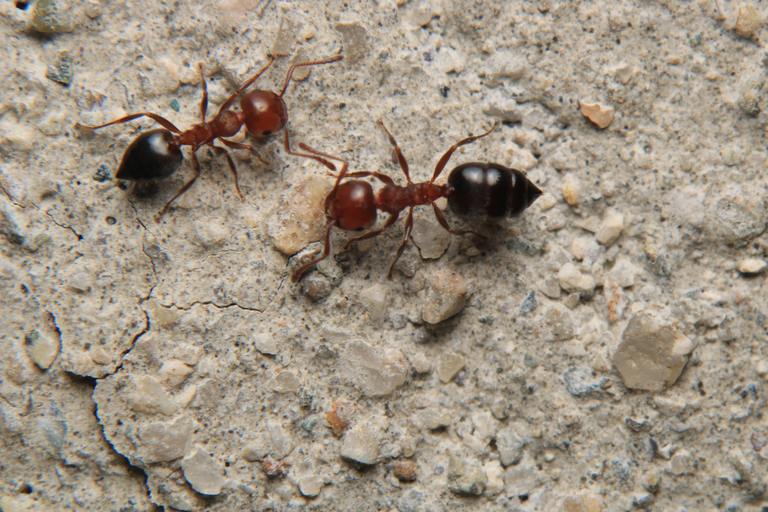
Color alone is not enough for identification. Depending on the species and caste, a carpenter ant may appear reddish brown, orange and black, mostly black, or brown. Workers in the same colony can also vary noticeably in size. Florida homeowners are often dealing with a bicolored ant that has a reddish or orange middle section and a dark head and abdomen.
Carpenter ants are part of Florida’s normal outdoor ecosystem. They often nest in trees, stumps, logs, roots, landscape timbers, and other sites containing protected cavities. Trouble begins when workers regularly enter a home or a colony establishes a nest in a structural void. Our ant pest library provides a broader overview of the ant species, warning signs, and colony-focused control issues homeowners may encounter.
What Do Florida Carpenter Ants Look Like?
Look at several features together instead of relying on color or size alone. A typical carpenter ant has:
- A clearly pinched waist
- Elbowed antennae
- One node at the waist between the thorax and abdomen
- A smoothly rounded upper profile through the thorax
- Workers of noticeably different sizes within the same trail
- A relatively large, sturdy body compared with many household ants
Workers are wingless. Reproductive males and females have wings before mating, and a newly mated queen sheds hers when she looks for a place to begin a colony. If winged insects are present, the front wings of an ant are longer than the rear wings. Termite swarmers have a broad waist, straight antennae, and two pairs of wings that are roughly equal in length.

Could a Large Ant Be Another Florida Species?
Yes. Florida has many ant species, and some can look similar at a glance. Size varies within carpenter ant colonies, so one unusually large ant is not enough to confirm the species. Photographs can help, but a clear specimen and the surrounding evidence are more useful.
Where the insects appear, when they are active, whether they form trails, and whether wood debris is present all help narrow the identification.
Fire ants usually draw attention through outdoor mounds and defensive stinging. Ghost ants are much smaller and often appear around kitchens and bathrooms. Bigheaded ants have workers with disproportionately large heads and commonly trail along exterior edges. Carpenter ants are more closely associated with large nocturnal workers, trees, structural voids, and excavated nesting material.
Do Carpenter Ants Eat Wood?
No. Carpenter ants cannot digest wood for nutrition. They use their mandibles to remove wood fibers and open smooth galleries where the colony can shelter and develop. They feed on proteins and sugars, including insects, sweet honeydew produced by plant-feeding insects, and foods available around a home.
This is one of the clearest differences between carpenter ants and termites. Termites consume cellulose. Carpenter ants carry excavated material away from a gallery and may deposit it below a small opening.
If you are comparing winged insects, wood damage, or debris, our guide to the signs of carpenter ants versus termites can help organize the visible clues. When the evidence is unclear, a professional inspection is safer than assuming that every wood-related problem is the same.
What Does Carpenter Ant Damage Look Like?
Carpenter ant galleries tend to follow softer portions of wood and have clean, smooth interior surfaces. You may also find coarse, irregular shavings outside an opening. That debris can contain wood fibers, insect pieces, insulation, and other material removed from the nest.
It is different from the uniform, pellet-like droppings associated with drywood termites and the soil-lined galleries associated with subterranean termites.
Visible debris is only a clue, not a measurement of the damage. A small pile may sit below a larger hidden gallery, while an isolated outdoor nest in an old stump may have no connection to the house. Our detailed guide to recognizing carpenter ant frass explains what to photograph, where to look, and why recurring piles matter.

Why Do Florida Carpenter Ants Enter Homes?
Workers enter homes because they find food, water, shelter, or a convenient route from an outdoor nest. A mature tree touching the roof can act like a bridge. Utility lines, plumbing penetrations, attic vents, gaps around windows, and unsealed roof edges can provide additional access.
Rain and humidity also shape activity. Heavy rainfall can disrupt outdoor foraging areas, while leaks and slow-drying wood make protected cavities more suitable for nesting. Air-conditioning systems can create condensation, and wind-driven rain may repeatedly wet window trim, soffits, porch columns, or siding seams.
These conditions do not automatically mean a colony is inside, but they create places worth inspecting.
Food is part of the picture too. Workers may visit kitchens, outdoor dining areas, pet bowls, garbage containers, and recycling bins for sugars or proteins. Seeing a trail toward food does not reveal where the colony is located. The ants may travel a considerable distance between the food source and an outdoor tree or hidden satellite nest.
A guide to interpreting ant trails into the home can help you preserve useful clues before wiping the trail away.
Where Do Florida Carpenter Ants Usually Nest?
Outdoors, common nesting sites include:
- Hollow or moisture-damaged trees
- Dead limbs, stumps, logs, and buried roots
- Fence posts and landscape timbers
- Wood piles and construction scraps
- Cavities beneath bark or inside damaged wood
- Protected voids around decks, sheds, and outdoor structures
Indoors, inspectors pay special attention to places with present or past moisture:
- Window and door frames exposed to rain
- Roof edges, soffits, fascia, and attic framing near leaks
- Wall voids near plumbing lines
- Areas around tubs, showers, sinks, and dishwashers
- Porch posts, columns, and deck attachments
- Crawl spaces with condensation or poor ventilation
- Foam insulation, hollow doors, and other protected voids
A colony may include a parent nest and one or more satellite nests. The parent nest generally needs higher humidity because it contains the queen, eggs, and young larvae. Satellite nests can contain workers, older larvae, and pupae and may occupy somewhat drier voids.
This arrangement is one reason surface spraying can miss the real source.
What Signs Suggest a Nest Is Inside the House?
An ant indoors is not automatic proof of an indoor colony. Workers from an outdoor nest can enter to forage and then return outside. The pattern of activity is more informative than a single sighting.
Signs that raise concern include:
- Repeated nighttime activity in the same room. Carpenter ants frequently forage after sunset. A consistent trail disappearing into a wall, ceiling, cabinet void, or window frame deserves attention.
- Coarse debris that returns after cleanup. Recurring shavings below a crack or small opening suggest ongoing excavation or nest cleaning.
- Numerous winged ants emerging indoors. A group of reproductives appearing from a wall or ceiling is much stronger evidence of an indoor nest than one winged queen near an open door.
- Rustling in a quiet wall or void. A large active colony can sometimes produce faint, dry movement sounds, although normal building noises can be misleading.
- Moisture damage near the activity. Staining, soft trim, bubbling paint, a musty odor, or a known leak makes the area more suspicious.
- A trail connecting the structure to a tree or wood source. This may reveal an outdoor parent nest supporting activity at the house.
The carpenter ant guidance from university extension specialists emphasizes that successful control depends on locating the nest, replacing damaged wood, and correcting moisture problems. Those principles apply especially well in Florida, where moisture conditions can return quickly.
Are Florida Carpenter Ants Dangerous?
They are not known for stinging people. A worker can bite if handled or trapped against skin, and some carpenter ants can use formic acid defensively, which may make the area feel irritated.
For most homeowners, the main concerns are not medical. They are hidden nesting, moisture damage, and gradual wood excavation.
The amount of structural risk depends on the location, size, and age of the colony and on the condition of the wood before the ants arrived. Carpenter ants often take advantage of wood already softened by water or decay. Their excavation can compound that existing weakness.
Serious damage generally develops over time, but waiting for obvious failure is not a sensible way to judge a hidden wood problem.
Termites remain a separate and significant Florida concern. If you find mud tubes, uniform pellets, extensive blistering, or swarmers that do not match ant features, review the company’s termite treatment and prevention information and arrange for the evidence to be identified accurately.

How to Get Rid of Florida Carpenter Ants
Effective control starts with finding out whether you have occasional foragers, an outdoor nest close to the structure, or a colony established in or around the building. Killing a few workers does not answer that question. Only a small portion of the colony may be visible at any one time.
1. Document the Activity
Note the time, room, direction of travel, and approximate number of ants. Photograph workers, winged insects, trails, debris, and moisture staining. Avoid immediately cleaning every clue. A technician can use the location and movement pattern to focus the inspection.
2. Inspect for Moisture and Access Routes
Check for plumbing leaks, roof leaks, clogged gutters, failing caulk, sprinkler overspray, wet porch posts, and condensation around air-conditioning components. Look outside for branches touching the roof, vines against siding, stacked firewood, buried wood, and damaged trees near the structure.
Do not open walls, drill into suspected nests, or disturb electrical and plumbing areas. Hidden cavities can contain wiring, pipes, mold, or other hazards. A moisture meter and a careful building inspection are often more useful than destructive searching.
3. Avoid Depending on Contact Spray
A contact product may kill ants that cross the treated surface, but it may leave the queen, brood, and most workers untouched. It can also disrupt the trail an inspector needs to follow. Random indoor spraying adds pesticide exposure without proving that the nest has been reached.
If a homeowner chooses to use any pesticide, the product must be labeled for the pest and the intended site, and every direction and precaution on the label must be followed. The EPA’s pesticide safety guidance for households also recommends reducing food, water, and shelter conditions and warns against using more product than the label directs.
4. Target the Colony and Correct the Conditions
Professional control may involve strategically placed baits, targeted void treatment, exterior nest treatment, or a combination selected after identification and inspection. Product choice and placement depend on where the colony is located and how the ants are moving.
Treating every carpenter ant situation the same way is unlikely to produce consistent results.
Moisture repair and damaged-wood replacement are part of the solution, not an optional finishing touch. Pest treatment can remove the active colony, but it cannot repair leaking flashing, improve drainage, or replace decayed trim. Those building corrections reduce the chance that the same area will support another colony.
What Should Homeowners Expect From a Professional Inspection?
A useful carpenter ant inspection should answer more than, “Are these ants?” The technician should work to identify the species, map active trails, inspect likely nesting and moisture areas, evaluate exterior sources, and distinguish carpenter ant evidence from termite or beetle evidence.
Depending on the home, the inspection may include the attic, crawl space, roofline, plumbing-adjacent walls, window and door frames, porch structures, trees, stumps, landscape timbers, and utility entry points. The goal is to connect the visible activity to a likely source and build a treatment plan around colony behavior.
Ask these questions during the visit:
- Do the specimens and signs confirm carpenter ants?
- Does the evidence suggest an indoor nest, outdoor nest, or both?
- Which moisture or wood conditions are supporting the activity?
- How will the treatment reach the colony rather than only exposed workers?
- What should be repaired, trimmed, moved, or sealed after control?
- What activity is normal after treatment, and when should follow-up occur?
Florida homes face different pressures depending on their age, construction, tree cover, drainage, and region. Homeowners can review All U Need Pest Control’s Florida pest control coverage and local service approach when deciding what kind of ongoing prevention fits their property.

How Can You Prevent Carpenter Ants From Returning?
Prevention works best as routine home maintenance rather than a one-time cleanup. Focus first on water and wood conditions, then reduce access and food sources.
- Repair roof, plumbing, window, and irrigation leaks promptly.
- Keep gutters and downspouts clear and direct water away from the foundation.
- Replace decayed trim, fascia, porch wood, and other damaged material.
- Trim branches and shrubs so they do not touch the roof or siding.
- Move firewood, lumber, and cardboard away from the structure and keep them dry.
- Remove dead stumps, buried wood, and unnecessary landscape timbers near the house.
- Maintain a visible gap between mulch and vulnerable siding or trim.
- Seal gaps around windows, doors, vents, and utility penetrations after active ant pressure is controlled.
- Store pantry foods and pet food in sealed containers and clean sugary spills promptly.
- Recheck areas that have leaked before, especially after heavy rain or storms.
These steps cannot guarantee that an outdoor ant will never cross the property. They do make the home less suitable for a colony and make new activity easier to detect before it becomes established.
The Bottom Line for Florida Homeowners
Florida carpenter ants are common outdoors, so a single ant does not always signal structural trouble. Repeated indoor trails, recurring coarse debris, winged ants emerging from a void, or activity concentrated near wet wood deserves a more careful response.
The most important question is not how quickly you can kill the ants in view. It is whether a colony is using the structure and what condition made that possible.
Accurate identification, patient inspection, colony-focused treatment, moisture correction, and wood repair form the strongest long-term plan. When those pieces work together, homeowners can address the current activity while making the property less inviting to the next colony.