Termite Queen: How She Builds a Colony and Why Homeowners Rarely See Her

Published: August 12, 2026
Introduction
A termite queen is central to the growth of a termite colony, but she is not a giant insect roaming through walls and personally chewing the wood. She remains hidden within protected colony areas, where her primary role is reproduction. Workers find food, maintain tunnels, care for young, and feed other colony members. Soldiers defend the group. The king remains with the queen and continues contributing to reproduction.
That division of labor helps explain why termite problems are difficult to understand from the few insects a homeowner may see. Pale termites exposed in damaged wood are usually workers. Dark-headed individuals may be soldiers. Winged termites around a window are reproductive swarmers leaving to form new colonies. The queen is normally far from the visible feeding site.
Learning how the royal pair and the rest of the colony work together makes one pest-control principle much clearer: killing the termites in one board does not necessarily reach the reproductive system sustaining the larger colony.
What Is a Termite Queen?
A termite queen is a reproductive female that helps establish and populate a colony. She begins life as a winged reproductive termite, also called an alate or swarmer. After leaving a mature colony, pairing with a male, and finding a suitable nesting location, she sheds her wings and becomes a primary reproductive. Her partner becomes the king.
The pair begins with a small protected chamber. During the colony's earliest stage, they care for the first eggs and young themselves. As workers develop, those workers take over nest expansion, feeding, grooming, and brood care. The queen can then devote far more energy to egg production.
Termite societies vary by species. Some colonies rely heavily on one primary royal pair. Others may contain supplemental or replacement reproductives that also lay eggs. For that reason, the familiar picture of one queen controlling every termite from one permanent throne room is an oversimplification.
For a broader introduction to termite types and behavior, All U Need Pest Control's termite information and control overview explains how subterranean and drywood colonies interact with homes differently.

What Does a Termite Queen Look Like?
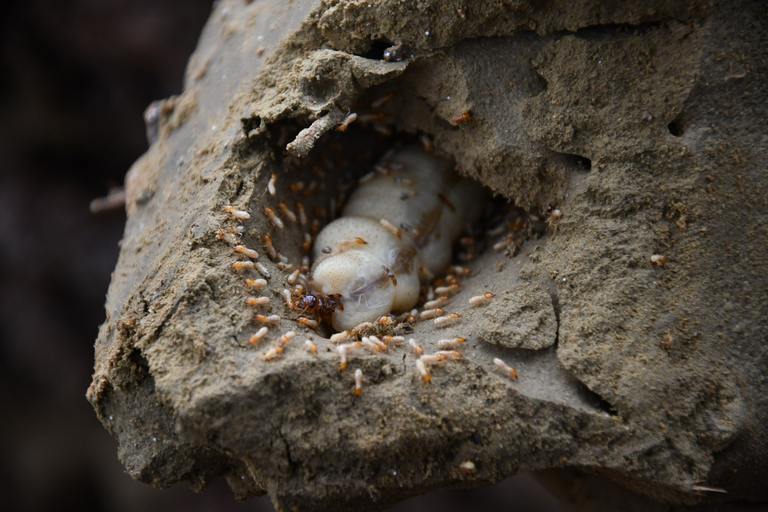
Appearance changes with species, age, and reproductive development. A newly paired queen initially resembles the winged termite she was before the swarm, minus the wings. Small wing stubs or scars may remain where the wings broke away.
As egg production increases in many species, the abdomen becomes enlarged. This condition is called physogastry. The head and thorax remain relatively small while the abdomen lengthens and expands, making a mature queen look very different from workers and soldiers.
General features may include:
- A body larger than nearby workers
- A pale, cream, yellow-brown, or darker color depending on species and stage
- A greatly enlarged abdomen in a mature, highly reproductive queen
- Short legs that appear small relative to the abdomen
- No functional wings after colony establishment
- Workers gathered around her to feed, clean, and care for eggs
Images online sometimes show enormous queens from tropical termite species. Those examples should not be treated as a universal size guide for every structural termite found in the United States. Queen size and appearance differ considerably among termite groups.
How Does a Termite Queen Start a Colony?
The process begins with a mature parent colony producing winged male and female reproductives. Under suitable weather conditions, these swarmers leave in large numbers. Most do not successfully establish colonies. They may dry out, be eaten, fail to find a mate, or land where conditions cannot support them.
The survivors follow a basic sequence:
- A male and female leave the original colony during a swarm.
- They land and shed their wings.
- A pair forms and searches for a protected nesting site.
- The pair seals itself into a small chamber.
- The female lays the first group of eggs.
- The king and queen care for the earliest young.
- New workers gradually assume feeding, grooming, construction, and brood care.
- Colony growth accelerates as the reproductive system and worker population expand.
University of Georgia Cooperative Extension explains that new subterranean colonies begin with a paired king and queen. Initial growth is slow, but egg production and colony growth increase as the queen ages and workers take over colony labor.
Homeowners are far more likely to see the swarmers that start this process than the resulting royal pair. All U Need Pest Control's guide to what flying termites mean around a home explains why the location of a swarm matters.
Does the Termite King Stay With the Queen?
Yes. Termites differ from many familiar social insects because the founding male does not simply mate and die. The king remains associated with the colony and mates with the queen throughout their reproductive lives.
This continuing royal pair is one reason termite social biology differs from the better-known honeybee model. Termite colonies also include both male and female workers or immature worker-like individuals, depending on species.
The king is typically much smaller and less physically dramatic than a mature queen. Both reproductives remain protected and depend increasingly on workers as the colony develops.

How Many Eggs Can a Termite Queen Lay?
There is no single reliable number for every species or every stage of colony development. Egg production begins modestly in a new colony and increases as the queen matures, workers become available, and conditions support growth.
Species, queen age, temperature, moisture, food availability, colony size, and the presence of supplemental reproductives can all affect total production. Mature queens of some species can produce very large numbers of eggs, but homeowners should be cautious with dramatic per-day figures presented without a species or research context.
The practical takeaway is simpler: a colony does not begin at full strength. It develops gradually. Once it has enough workers to gather food, care for young, and support reproductives, growth can accelerate and the colony may eventually produce its own swarmers.
How Long Can the Queen Live?
Termite queens are unusually long-lived insects. Their lifespans vary widely, but queens and kings of some species can survive for many years and, under favorable conditions, potentially much longer than ordinary workers.
Longevity depends on species, habitat, colony health, predation, temperature, moisture, and other environmental conditions. A queen living inside protected soil or wood avoids many of the hazards faced by swarmers and foraging termites.
Research cataloged by the U.S. Forest Service has examined the longevity of kings and queens under different reproductive strategies, illustrating that royal lifespan and colony development are species-specific biological questions rather than one fixed number.
Her long potential life is only part of the colony's resilience. Replacement reproductives can sometimes continue egg production if a primary queen declines or dies.
What Happens When the Primary Queen Dies?
The colony does not always collapse. In some termite species, immature individuals can develop into neotenic reproductives, sometimes called secondary or replacement reproductives. These termites mature inside the colony without first leaving as fully winged swarmers.
Replacement reproduction can serve several purposes:
- Replacing a dead or failing primary queen
- Increasing egg production in an expanding colony
- Supporting sections of a colony that become separated
- Helping establish satellite activity where conditions allow
Several supplemental reproductives can collectively produce substantial numbers of eggs even though each may be less productive than a mature primary queen. Colony reproductive structure can therefore range from one main queen to multiple egg-laying reproductives.
This is one reason “find and kill the queen” is not a realistic homeowner control plan. The queen is concealed, the colony may occupy a distributed network, and the reproductive system may be more complex than one individual.

Why Do Homeowners Almost Never Find the Queen?
The termites found inside damaged wood are usually members of a feeding and travel network rather than the royal pair. With subterranean species, workers can forage through soil and protected tubes across a considerable area. The queen may be located somewhere else within the colony's occupied network.
She also avoids open air and light. Workers maintain the humid, protected conditions needed by vulnerable colony members, bring food, remove waste, groom the reproductives, and move or tend eggs.
The University of California's integrated pest management guidance describes how workers care for eggs, immatures, the queen, and other nestmates. Those workers are the insects homeowners are most likely to expose when breaking open a mud tube or damaged board.
If you find pale termites or darker-headed defenders, All U Need Pest Control's article on worker and soldier termite activity explains what those castes reveal about an active colony.
Is the Queen Located Inside the House?
Sometimes reproductive termites may occupy part of a structure, but homeowners should not assume the queen is directly behind the wall where damage appears.
Location depends on termite type:
Subterranean termites
Subterranean termites are closely associated with soil and moisture. Their feeding network may extend through soil, roots, buried wood, mud tubes, foundation gaps, and multiple structural food sources. Reproductives and young may shift among occupied sites rather than remain in one simple central nest that a homeowner can locate.
Drywood termites
Drywood termites live within the wood they infest and do not need a soil connection. Their reproductives, eggs, and other colony members may all remain concealed inside furniture, trim, framing, or another wooden item.
Formosan subterranean termites
Formosan termites are soil-associated but can establish aboveground carton nests when sufficient moisture is available. Persistent roof leaks, plumbing moisture, or other wet structural conditions may allow colony activity above the soil line.
Professional identification matters because colony location, behavior, and treatment needs change with the termite group. All U Need Pest Control's subterranean termite pest library provides more context on soil-connected foraging and colony-focused protection.
Does Seeing Baby Termites Mean a Queen Is Nearby?
Small pale termites are easy to call babies, but size and color alone do not prove that newly hatched termites or eggs are nearby. Workers are also pale, soft-bodied, wingless, and relatively small.
True eggs and very young termites are normally cared for in protected colony areas. A homeowner opening damaged wood is more likely to expose workers and soldiers than a royal chamber or nursery.
Seeing multiple pale termites still matters because it can indicate active feeding or travel. It simply does not pinpoint the queen's location. Photograph the insects and the surrounding evidence, preserve a sample if possible, and avoid spraying or destroying the area before it can be identified.

Can You Eliminate a Colony by Killing the Queen?
In theory, reproduction is essential to long-term colony survival. In practice, physically locating and killing a termite queen is not a dependable control method.
There are several reasons:
- The queen is deeply concealed and rarely accessible.
- The visible termites may be far from reproductive areas.
- Subterranean colonies can occupy distributed feeding sites.
- Replacement reproductives may develop in some species.
- Spraying one group of workers does not necessarily reach other colony members.
- Disturbing activity can make later inspection and treatment more difficult.
Effective termite management is designed around species behavior and the structure. Depending on the situation, professionals may use bait systems, liquid soil applications, direct wood treatment, localized methods, fumigation, monitoring, or combinations of approaches.
For subterranean termites, colony-oriented baiting uses workers' natural food-sharing behavior to move an active ingredient among nestmates. The goal is not for a technician to dig through the property searching for a queen. It is to affect the colony through the workers already traveling between food and other members.
This guide to subterranean termite treatment and follow-up explains why soil access, station placement, moisture correction, and monitoring are part of the plan.
What Does Queen Biology Mean for Homeowners?
The biology of the termite queen turns several common observations into practical lessons.
First, the termites you see are only a small sample of the colony. Workers in one baseboard or mud tube do not show where every occupied area or reproductive termite is located.
Second, a swarm is a reproductive event. Winged termites are leaving a mature colony and attempting to begin new ones. Vacuuming the swarmers removes those insects, but it does not address the colony that produced them.
Third, visible activity should be preserved for identification. Random sprays, broken tubes, discarded wood, or quickly covered repairs can remove evidence without resolving the source.
Finally, prevention and monitoring need to continue after treatment. Termite pressure can return from other colonies in the surrounding environment even after one colony is controlled. All U Need Pest Control's termite prevention guidance explains how moisture control, foundation visibility, wood storage, and ongoing protection work together.
A Colony Is More Than Its Queen
A termite queen begins as a winged reproductive, pairs with a king, and helps establish a colony that becomes increasingly organized as workers and soldiers develop. Over time, workers assume nearly every daily task around her, while she and the king sustain reproduction.
She is important, but she is not the only reason a termite colony is resilient. Food-sharing workers, defensive soldiers, developing young, flexible caste pathways, and possible replacement reproductives all contribute to survival. That complexity is why surface spraying or removing one damaged board rarely solves an established problem.
Homeowners do not need to locate the queen. They need accurate identification, an inspection that accounts for the termite species and structure, and a control plan capable of reaching more than the insects visible at one feeding site.